EFFRETIKON & WINTERTHUR

Shockwave Therapy

Shockwave therapy is a non-invasive method used for long-standing tendon and soft tissue complaints. At Rike-Hus in Effretikon and Winterthur, our physiotherapy team uses it as part of a treatment concept.

What is shockwave therapy and how does it work?

In shockwave therapy, mechanical-acoustic pressure waves are delivered into the tissue from outside the body. At Rike-Hus, our physiotherapy team uses the method for long-standing complaints affecting tendons and muscle attachments.

The pressure waves can influence local blood circulation and tissue metabolism. The aim is to trigger the body’s own adaptation processes. The evidence varies depending on the indication and response differs from person to person; treatment success cannot be guaranteed.

Common areas of application

Plantar Fasciitis & Heel Spur

Used for long-standing irritation of the plantar fascia and for heel pain.

Achilles Tendinopathy

Used for long-standing overuse complaints of the Achilles tendon.

Calcific Shoulder (Calcific Tendinitis)

Used as an accompanying treatment for tendinopathies of the rotator cuff. A prior medical assessment is required.

Tennis & Golfer’s Elbow

Used for long-standing complaints at the tendon attachments of the elbow.

Patellar Tendinopathy (Jumper’s Knee)

Used for load-related complaints of the patellar tendon.

Greater Trochanteric Pain Syndrome

Used for long-standing complaints in the area of the greater trochanter.

Our treatment approach at Rike-Hus

We do not use shockwave therapy on its own, but as part of a comprehensive physiotherapy concept based on a thorough assessment.

It often serves as preparation to make a gradual increase in load possible. We complement it with active exercises, manual techniques and individual load adjustments.

Benefits of shockwave therapy for you

Non-Invasive

Applied from outside the body, without incisions and without surgery.

Locally Targeted

The impulses are delivered locally to the region identified in the assessment.

Tissue Activation

The aim of the treatment is to stimulate local blood circulation and tissue metabolism.

Combinable

Can be combined with active physiotherapy and training therapy.

For Long-Standing Complaints

Can be considered as a complementary option for long-standing complaints.

Short Treatment Time

The treatment takes only a few minutes and is usually integrated into a therapy session.

Who is the treatment suitable for?

Shockwave therapy may be an option for people of different activity levels who suffer from localized or long-standing complaints affecting tendons and tendon attachments.

Patients with chronic tendon complaints
For tendon attachment complaints that have persisted for several months, shockwave therapy can be considered as a complementary measure.
Physically active people
For physically active people, the treatment is used alongside an adapted training progression.
People looking for conservative options
Shockwave therapy is a conservative method. Whether it is an option in an individual case must be clarified by a physician and a physiotherapist.

How the therapy works in 4 steps

01. Examination & assessment

Examination of the affected structures and clarification of the indication and contraindications.

02. Localization

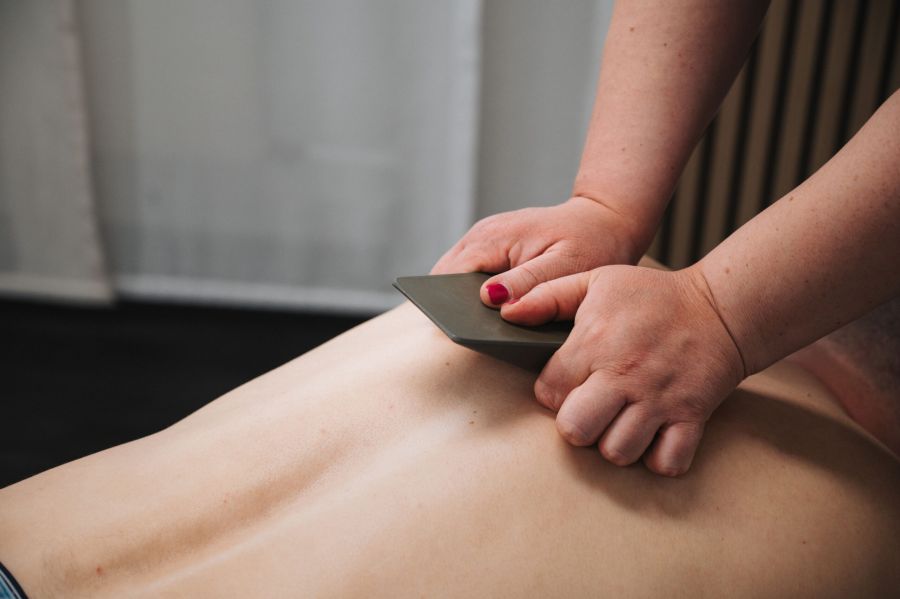
Locating the target area and applying contact gel to transmit the impulses.

03. Shockwave application

Delivery of the pressure waves at an individually adjusted intensity and frequency.

04. Active integration

Complemented by stretching and strengthening exercises as part of the load progression.

Frequently Asked Questions (FAQ)

Is shockwave therapy painful?
The treatment produces noticeable impulses in the tissue. We continuously adjust the intensity with you; please let us know at any time if it becomes uncomfortable.
How many sessions are needed?
Depending on the assessment findings and tissue response, 3 to 6 sessions are common, spaced a few days to a week apart. A binding prediction is not possible in advance.
How long does a treatment session last?
A shockwave session on its own usually takes about 10 to 15 minutes. It is often integrated into a regular physiotherapy treatment.
Are there any side effects?
Temporary redness, swelling, small bruises or muscle soreness in the treated area are possible. Shockwave therapy is not used in cases including clotting disorders or blood-thinning medication, acute infections, tumors in the treatment area and during pregnancy. We check for contraindications before the first treatment.
Is shockwave therapy covered by health insurance?
Shockwave therapy is not always covered by mandatory health insurance (OKP). Whether costs are covered depends on the indication, the medical prescription and your insurance coverage. We will inform you about the costs before treatment begins; your insurer can give you a binding answer.

More services at Rike-Hus

    Would you like to learn more?

    Let’s work together to determine whether shockwave therapy is right for your situation. Book an appointment in Effretikon or Winterthur.